
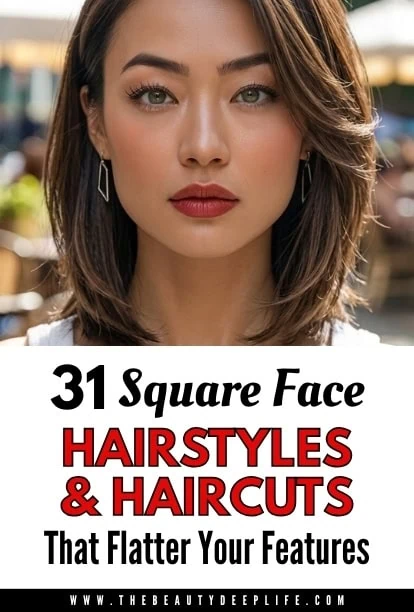
If you have a square-shaped face, you already have the kind of bone structure people try to fake with contour. A strong jawline, defined cheekbones, and a broad forehead give your square face plenty of natural structure, so choosing hairstyles isn’t necessarily about hiding any of it. It’s about deciding whether you want to soften those angles, play up your jaw, or change the proportions with a little strategic hair wizardry.
The best square face hairstyles often bring movement, curves, asymmetry, or height into the picture. Sweeping layers can break up strong lines, waves can add flow around the jaw, and a little crown volume can draw the eye upward. Even something as simple as shifting your ponytail to one side can make a difference.
And you definitely aren’t limited to long, cascading hair. Pixies, bobs, lobs, bangs, braids, ponytails, and loosely pinned updos can all work beautifully with a square face.
Ready to meet your next hairstyle or haircut? Let’s get into all 31.
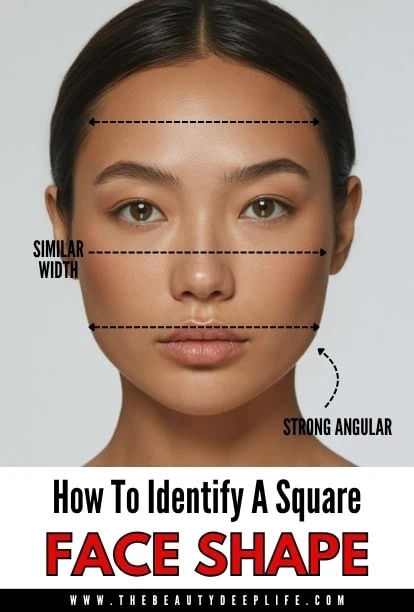
How To Identify A Square Face Shape
You’ve got a strong, angular jawline, with your forehead, cheekbones, and jaw all being roughly the same width. Your jaw corners are usually fairly defined rather than gradually tapering toward a narrow chin, and that broad forehead gives you some serious boss energy.
Square faces also tend to have relatively similar width and length, although we’re talking about faces here, not graph paper. You don’t need perfectly matching measurements to fall into this category.
What’s The Goal?
The goal is to soften those gorgeous, sharp angles, disrupt the pronounced symmetry of a square face, create the illusion of a longer, leaner bone structure, and add movement for a more balanced, flowing look.
Of course, that’s an option rather than a commandment. If your strong jawline is your favorite feature, show it off. These hairstyles simply give you different ways to work with your proportions through height, texture, layers, curves, and asymmetry.
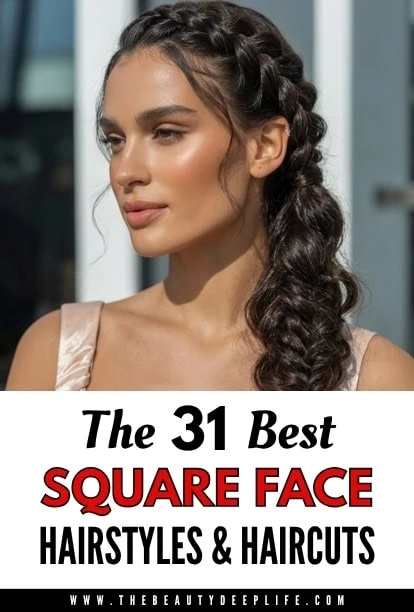
The 31 Best Square Face Hairstyles & Haircuts
1. Shaggy Pixie
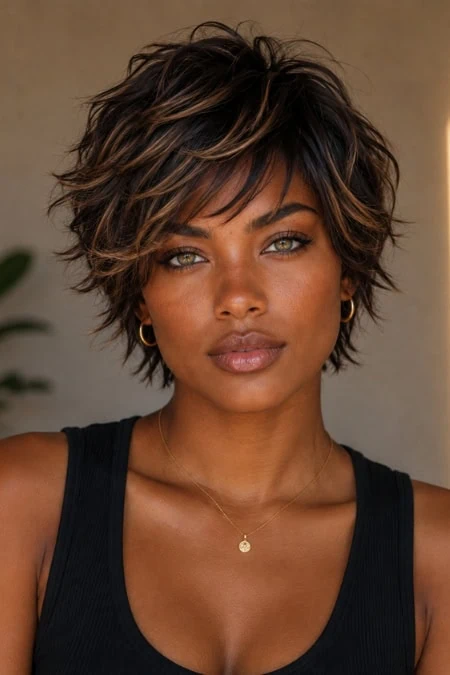
A shaggy pixie brings plenty of personality to short hair without boxing a square face into another rigid shape.
The cut relies on piecey layers, feathered ends, and deliberately tousled texture, so the perimeter heads in different directions instead of tracing one neat line around the face. That irregularity provides a nice contrast to a structured jaw and broad forehead.
Keep some length through the top and front so you have room to play with texture. The goal isn’t perfectly arranged pieces. A little disorder is doing you a favor here.
2. Soft-Layered Pixie
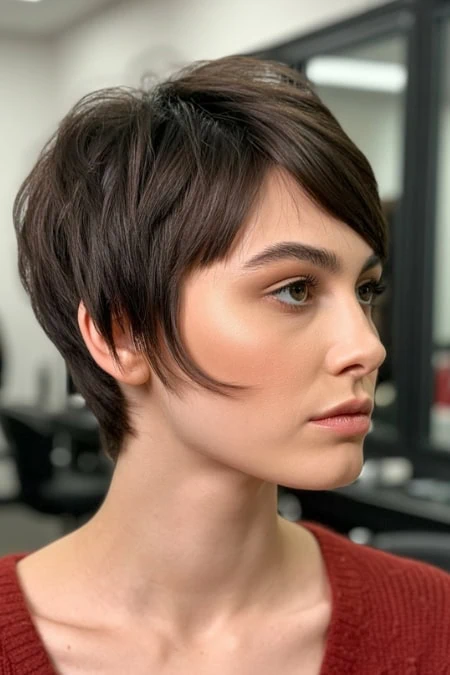
If a shaggy pixie is all about visible texture, the soft-layered pixie takes a quieter approach.
Here, the layers are graduated and blended rather than heavily chopped or separated. The transitions between lengths are subtle, giving the haircut a gentler outline while keeping the silhouette from appearing blocky.
This makes it a useful short haircut for a square face because the layers don’t duplicate the angular structure of the jaw. You still get the freedom and face-opening effect of a pixie, but with fewer hard lines around your features.
3. Pixie With Crown Volume
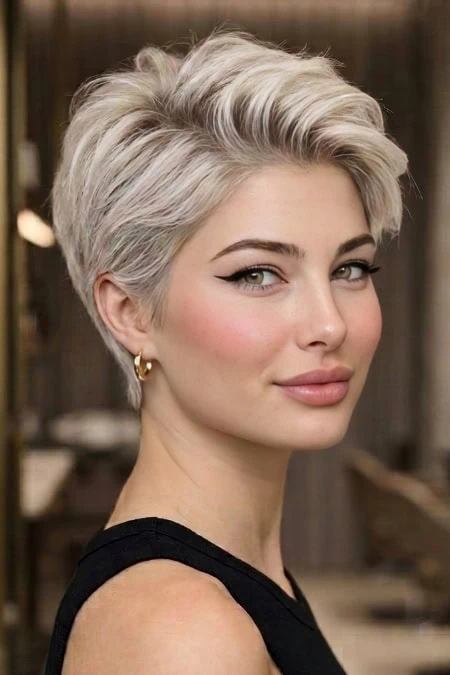
Our third pixie has one very specific assignment: go up.
Leaving more length through the top allows the hair to be lifted away from the head, producing noticeable volume through the front and crown. Meanwhile, keeping the sides relatively close avoids adding extra width around the cheekbones.
That vertical height can make a square face appear longer and shift attention toward the upper portion of the hairstyle.
You don’t need to tease it halfway to the ceiling, either. Controlled lift through the crown is enough to change the proportions.
4. Rounded Bob
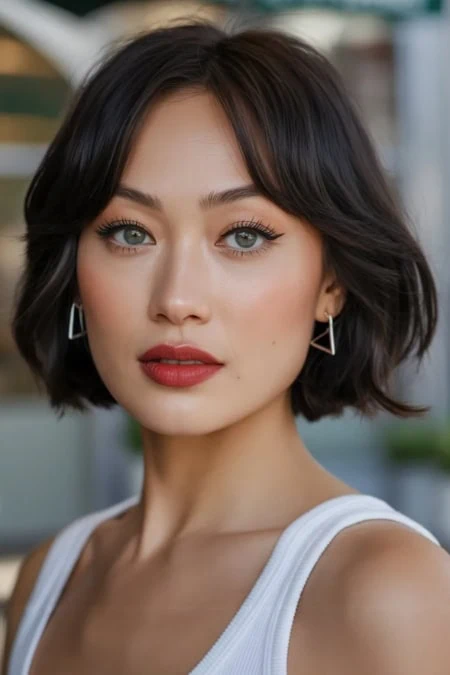
A rounded bob swaps sharp geometry for curves.
Rather than ending in a severe, ruler-straight perimeter, the ends bend gently inward to produce a more rounded silhouette. That curvature provides an interesting contrast against pronounced jaw corners.
The trick is avoiding too much bulk through the lower sides. A little separation through the ends prevents the bob from becoming one solid block of hair.
Curtain-like pieces around the front can introduce additional curves around the forehead and cheekbones.
5. Angled Bob
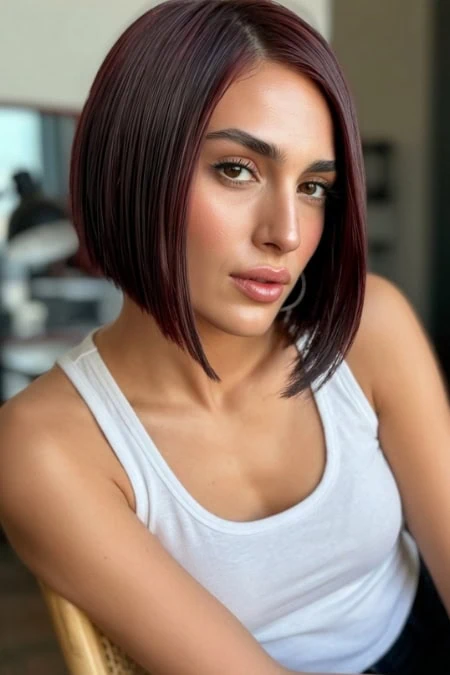
Here’s a bob that uses angles to its advantage.
An angled bob is shorter toward the back and gradually becomes longer toward the front, producing that distinctive diagonal perimeter. For a square face, the placement of those longer front sections matters. Ideally, they extend beyond the jaw instead of stopping directly at its widest point.
Those diagonal lines lead the eye downward rather than straight across the lower face, providing a subtle lengthening effect.
It’s proof that angles aren’t the enemy of an angular face. You just need them pointing in the right direction.
6. Angled Lob
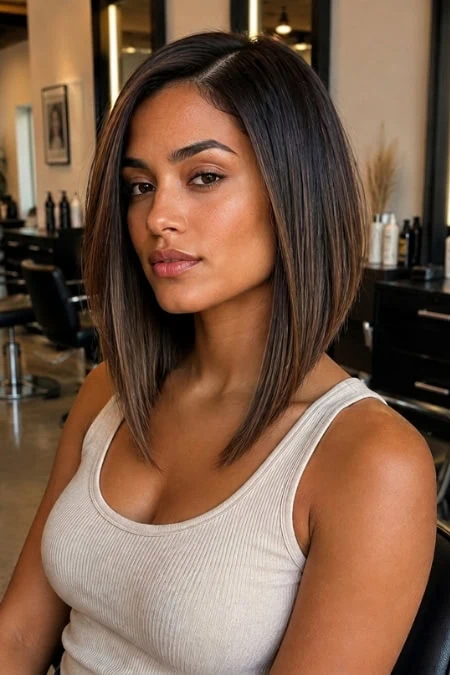
Want the same diagonal construction with a little more length? That’s where the angled lob comes in.
Like the bob, it’s shorter through the back and longer toward the front, but the overall cut extends closer to the shoulders or collarbone.
That additional length carries the eye farther below the jaw, adding a stronger vertical component to the haircut. It also gives you more styling room if you like alternating between straighter hair and loose bends.
7. Asymmetrical Lob
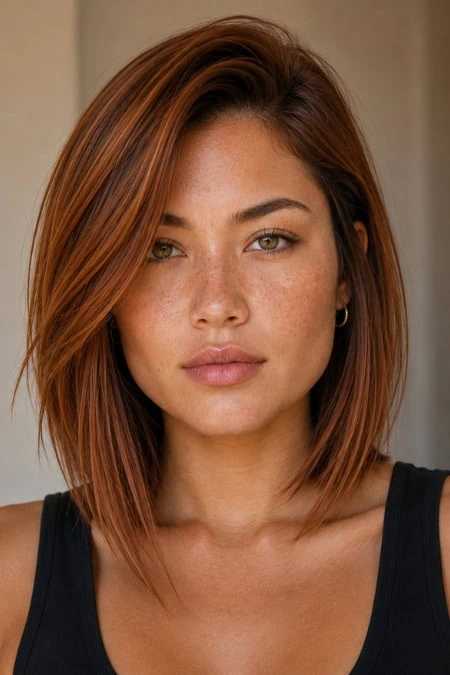
Square faces have naturally pronounced symmetry, so deliberately interrupting it can be surprisingly effective.
An asymmetrical lob leaves one side longer than the other, shifting the visual center of the haircut away from the middle. Instead of mirroring the face from left to right, the uneven perimeter creates a diagonal path for your eye to follow.
The difference in length doesn’t need to be dramatic. Even a subtle imbalance can give the haircut its defining shape.
8. Textured Wavy Lob
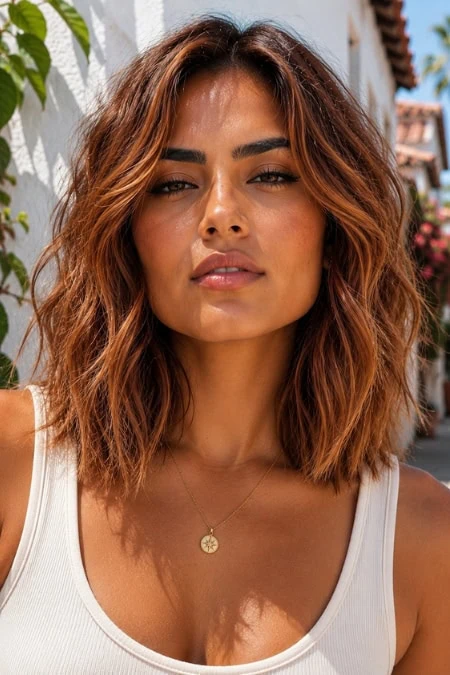
Sometimes the easiest way to make a lob work differently around a square face is simply to give it some bends.
A textured wavy lob uses irregular curves through the mid-lengths and ends to break up what could otherwise become a heavy horizontal line at the bottom of the cut. Because the overall length falls farther down the neck, you also maintain plenty of vertical direction.
Don’t make every wave identical. Slightly varied bends create more natural flow and keep too much volume from collecting in one spot beside the face.
9. Butterfly Haircut
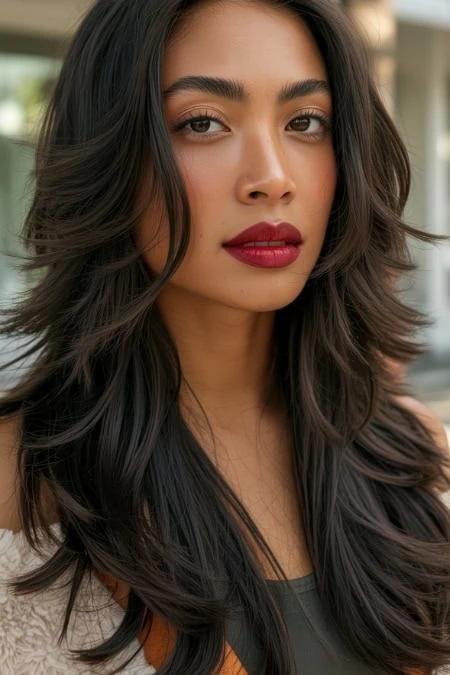
The butterfly haircut is basically a layering extravaganza, and that’s precisely why it earns a place here.
Shorter face-framing sections transition into progressively longer layers, creating a cascading, multi-layered shape through the hair. When those shorter pieces are styled away from the face, they sweep outward before flowing into the longer lengths.
You still retain plenty of length, but the overall silhouette becomes lighter and more dynamic.
For square faces, avoid having every short layer terminate at exactly the same point beside the jaw. Graduated lengths are what give the butterfly cut its signature airy shape.
10. Long Layered Hair
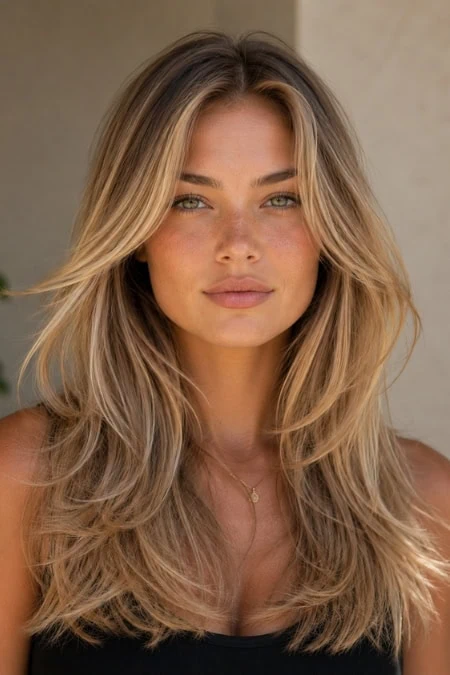
If you want to keep your length, layers can prevent long hair from becoming one heavy curtain around your face.
A long layered haircut removes weight at different points throughout the lengths, giving the hair more separation and dimension. Face-framing pieces can fall around the cheekbones and continue past the jaw, with the longest sections providing plenty of vertical direction.
Unlike the more dramatic face-framing of a butterfly cut, this style can distribute its layers throughout the hair for a gradual, blended effect.
It’s one of those square face hairstyles that can be adapted to practically any texture. The important part is maintaining enough variation in length that the perimeter doesn’t become too heavy or rigid.
11. Long Cascading Waves
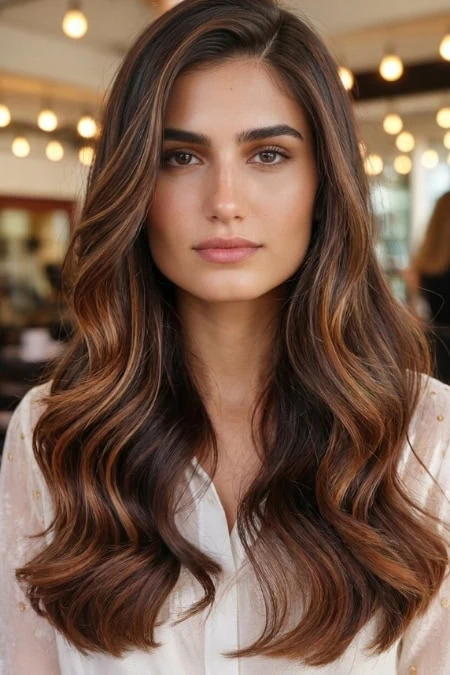
Unlike the previous two options, this one is less about a specific cut and more about how you style your length.
Long cascading waves bring two useful elements together: length and curves.
The length creates a clear downward direction, and the waves form rounded bends around the cheekbones, lower face, and shoulders. That combination contrasts nicely with the straighter outer lines of a square face.
Try starting the more noticeable bends around or below the cheekbones rather than concentrating all of your volume directly beside the jaw.
And if you love your jawline? Even better. The waves can surround it without covering up the feature entirely.
12. Long Shag With Side-Swept Bangs
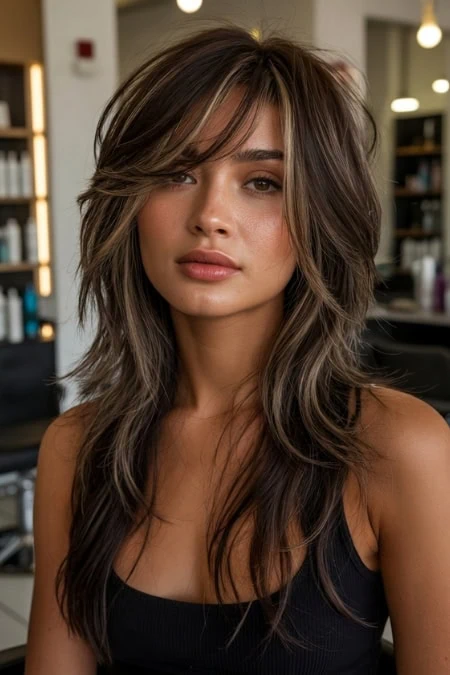
A long shag isn’t interested in behaving, which works rather nicely when you’re trying to break up facial symmetry.
Choppy layers and feathered lengths give the haircut an irregular outline, while side-swept bangs travel diagonally across the forehead rather than reinforcing its width with a straight horizontal line.
The combination carries texture from top to bottom. Keep the fringe long enough to blend naturally into the surrounding shag layers so the transition doesn’t appear abrupt.
13. Soft Shag With Wispy Bangs
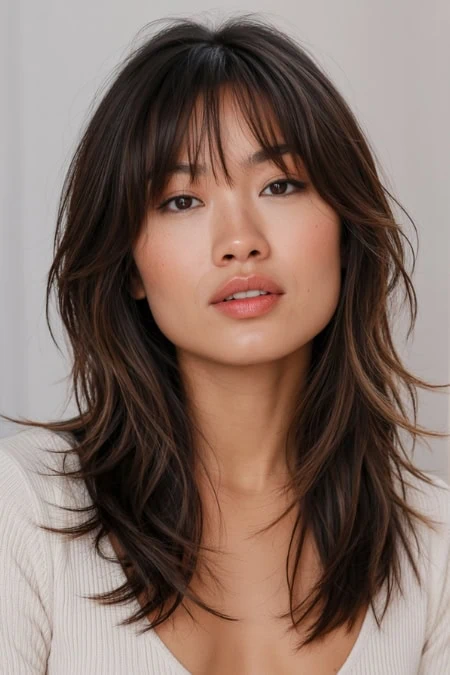
Think of this as the lighter, airier relative of the previous shag.
A soft shag with wispy bangs combines feathered ends and varied layering with a fine fringe that allows portions of the forehead to remain visible. Rather than creating one thick line across the upper face, the bangs separate into delicate pieces.
Meanwhile, the shag layers feather around the cheekbones and jaw, so the haircut never settles into a rigid outline.
If you want fringe without committing to something heavy, this one deserves a spot on the shortlist.
Bangs For Square Faces
Sometimes you don’t need an entirely new haircut. A few carefully placed snips around the forehead can change how the whole hairstyle frames your features.
For a square face, pay attention to the shape and direction of the fringe. Bangs that open, curve, or gradually change length can contrast with the horizontal and vertical lines already present in the face.
14. Bardot Bangs
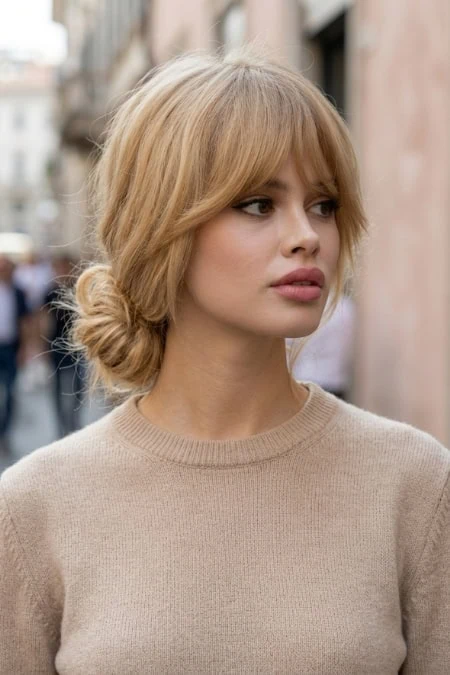
Bardot bangs generally give you more coverage through the center than traditional curtain bangs, but they don’t create the heavy straight-across line of a classic blunt fringe.
The center has a little more fullness without appearing heavy, and the outer pieces gradually become longer as they sweep toward the temples and cheekbones. That transition is what makes them especially interesting against a square face.
Instead of dividing the forehead with one solid line, the varying lengths curve outward around the upper face.
Keep the fringe slightly tousled rather than overly precise. Bardot bangs should have a bit of swagger to them.
15. Curtain Bangs
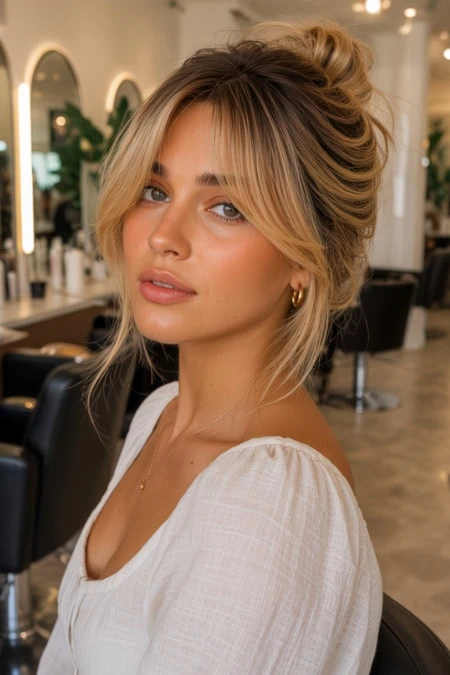
Curtain bangs take the open approach.
The fringe parts at the center before sweeping outward and gradually becoming longer toward the sides. That opening leaves some forehead visible, while the outer sections curve around the cheekbones.
On a square face, this can help interrupt the broad horizontal line of the forehead without completely covering it.
Style them outward rather than straight down so you get that distinctive curtain shape. Otherwise, the curtains have technically failed to open.
Ponytail Hairstyles For Square Faces
Don’t underestimate a ponytail. Placement, texture, crown height, and the pieces you leave around your face can completely change its effect.
16. Volumized Crown Ponytail
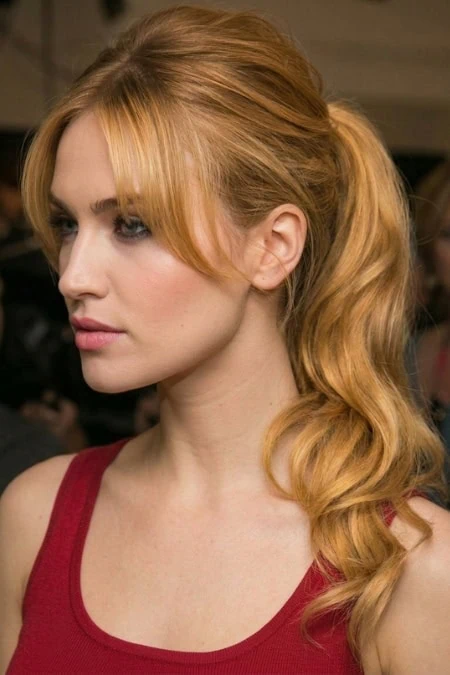
The volumized crown ponytail puts the emphasis exactly where its name promises.
Before securing the ponytail, maintain some lift through the crown instead of pressing the roots completely flat. That extra height extends the overall silhouette upward and can make a relatively broad face appear longer.
Loose waves through the ponytail keep the style from becoming overly structured. Longer front pieces prevent the front from appearing too severe.
17. Messy Textured Low Ponytail With A Deep Side Part
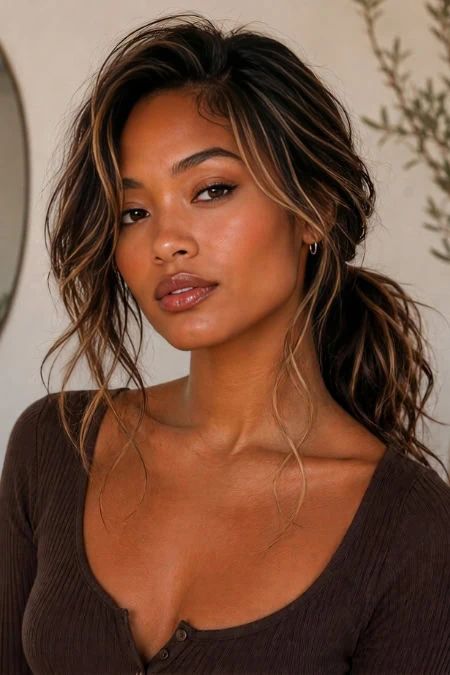
This low ponytail uses asymmetry rather than height.
Start with a deep side part, maintain some tousled texture through the hair, and secure the pony loosely near the nape. Release a few longer pieces around the front instead of pulling everything tightly away.
The part immediately disrupts symmetry through the forehead, while the free strands break up the outline around the lower face.
Low pony, high strategy.
18. Romantic Wispy Mid-Ponytail
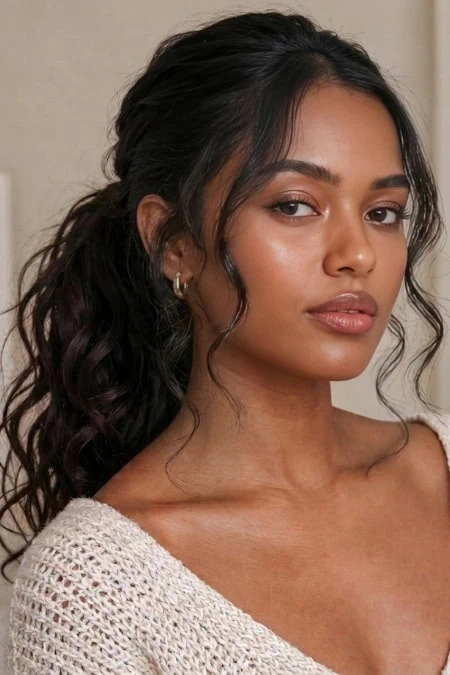
For this style, start with waves before reaching for your elastic.
Gather the hair loosely around mid-height, then pull out several delicate pieces around the temples, ears, and jaw. Those wispy strands break up the outline along the sides of the face, and the wavy ponytail keeps the overall shape relaxed.
The result still lets a strong jawline show without making the style appear severe.
19. Braided Ponytail
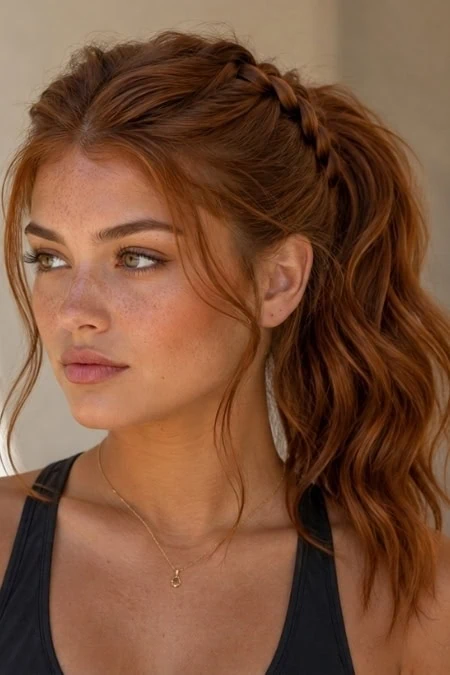
Adding a braid gives an ordinary ponytail more direction and detail.
In this variation, the braid is incorporated into the upper section before the hair transitions into the ponytail. That braided line draws the eye backward and adds definition through the top, with the ponytail extending the hairstyle behind the head.
Leave a couple of loose pieces around the face to keep the front from appearing too tightly pulled back.
20. Side Dutch Braid Ponytail
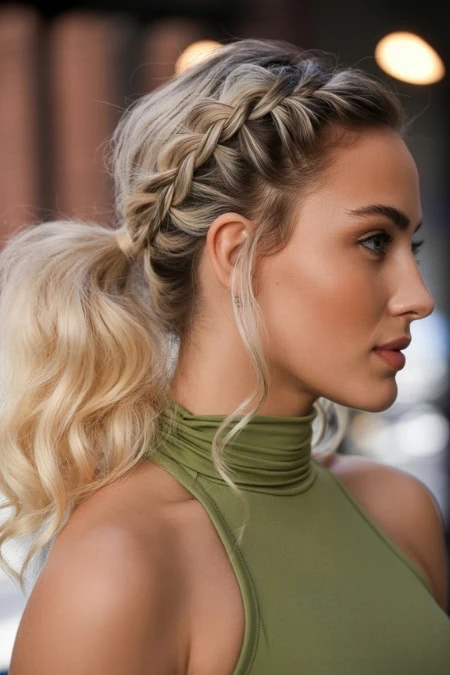
This version turns the braid into the main event.
A more prominent Dutch-style braid travels along the side of the head before feeding into the ponytail, creating an obvious diagonal direction. That off-center placement makes it particularly interesting for a square face because the hairstyle doesn’t mirror the face evenly from side to side.
Keep the ponytail wavy or lightly tousled so the lower section doesn’t become too rigid.
Braided Hairstyles For Square Faces
21. Side Braid Over The Shoulder
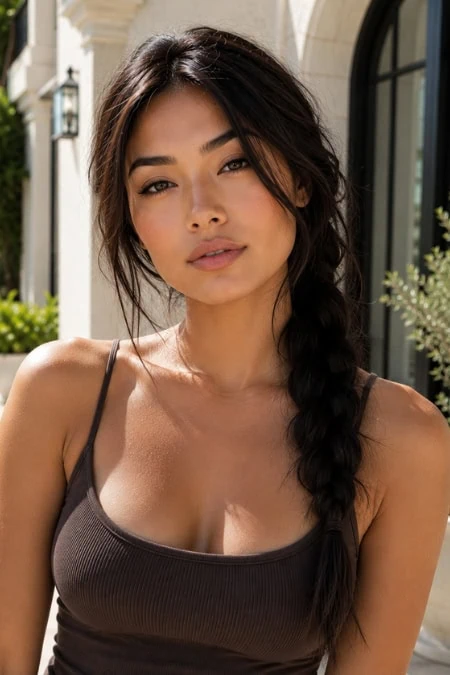
You may have noticed a theme by now: asymmetry is very useful when choosing square face hairstyles.
A side braid takes advantage of that by moving the visual weight completely to one side. Draping the braid over one shoulder creates an off-center focal point, and its long downward direction adds a vertical element beside the face.
Let a few strands escape around the forehead or cheekbones if you want an even more relaxed result.
22. Loose Bohemian Side Braid With Face-Framing Pieces
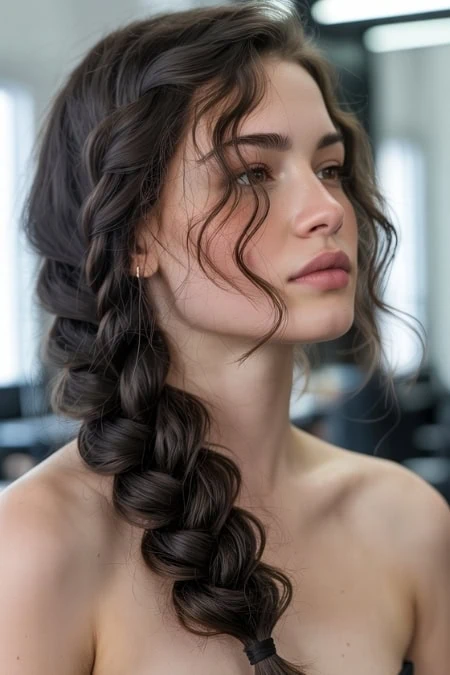
The bohemian side braid takes everything we liked about the previous style and loosens the screws.
The braid is wider, more irregular, and intentionally relaxed, with curled or wavy pieces left around the face. Those tendrils add curves near the cheekbones and lower face, with the braid itself keeping the hairstyle asymmetrical.
The trick is not making it too neat. This braid should look like it has somewhere more interesting to be.
Updos For Square Faces
23. Bun With Face-Framing Pieces
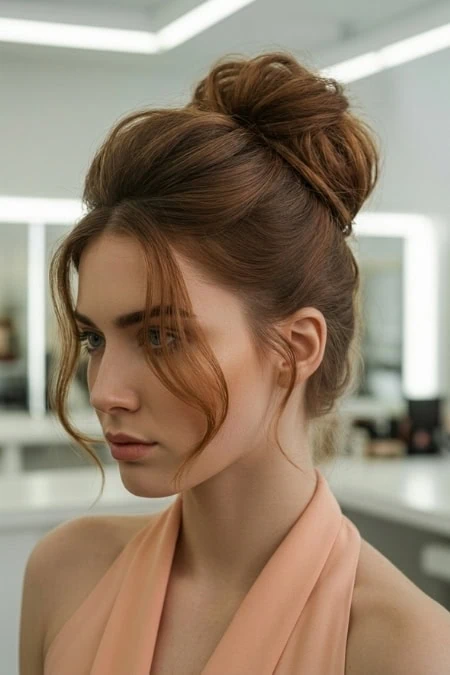
A bun like this gives you height without stripping every strand away from your face.
Gather the hair upward into a relaxed bun and intentionally release longer pieces around the temples, cheekbones, and jaw. The bun draws attention toward the top of the head, and those falling strands add curves around the sides.
It’s a simple formula, but a very useful one for a square face: height above + face-framing below.
24. Loose Updo
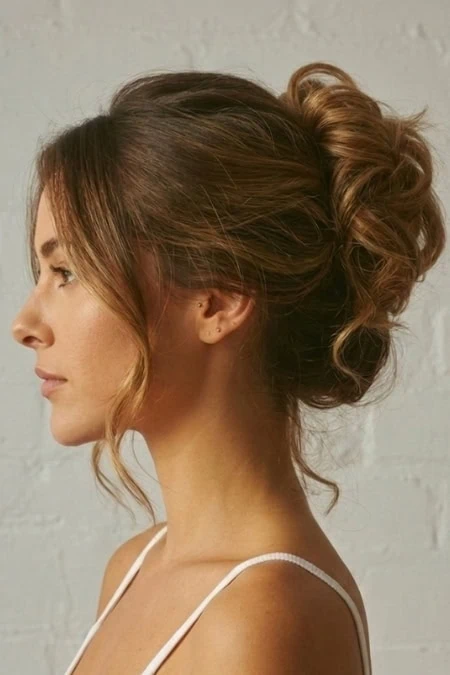
Not every updo needs to be shellacked into submission.
An intentionally undone updo keeps visible texture through the upper section, with a few tendrils escaping naturally. That irregularity contrasts with a defined jaw and keeps the hairstyle from becoming overly symmetrical.
Rather than pressing the roots flat, maintain some airy volume around the crown and sides. The result should look artfully relaxed, not like your bobby pins have declared independence.
25. Wavy Low Side Chignon
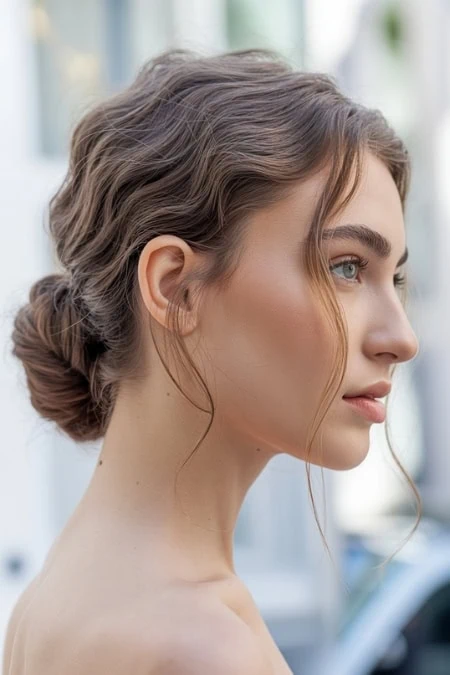
A low side chignon shifts the focal point away from the center while keeping the overall shape close to the nape.
The off-center placement immediately breaks up symmetry, and working with wavy hair gives the chignon more curved texture than a tightly coiled bun.
Leave one or two longer strands around the front to echo those curves beside the face. This is a dressier option that still avoids the severity of a tightly pulled-back updo.
26. Braided Crown Updo
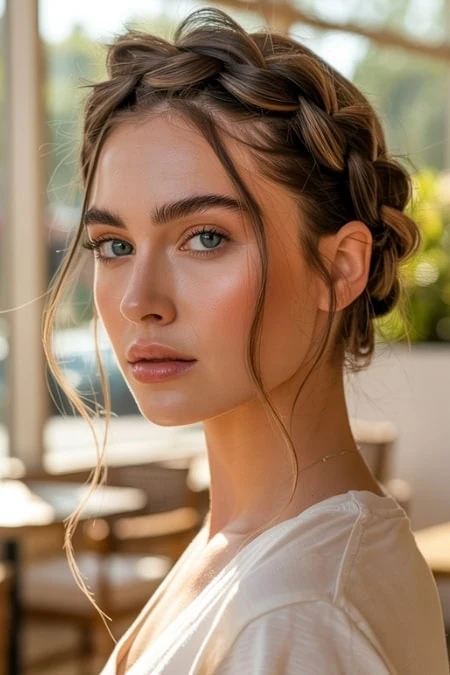
A braided crown sends the attention north.
Positioning the braid around the upper portion of the head creates detail and dimension above the forehead, while a slightly elevated shape can give the hairstyle additional height.
Keep the braid a touch relaxed rather than pressing every section flat. A couple of longer pieces around the front can also keep the overall shape from appearing too rigid against angular features.
Half-Up Hairstyles For Square Faces
27. Half-Up Twist-Back With Tendrils
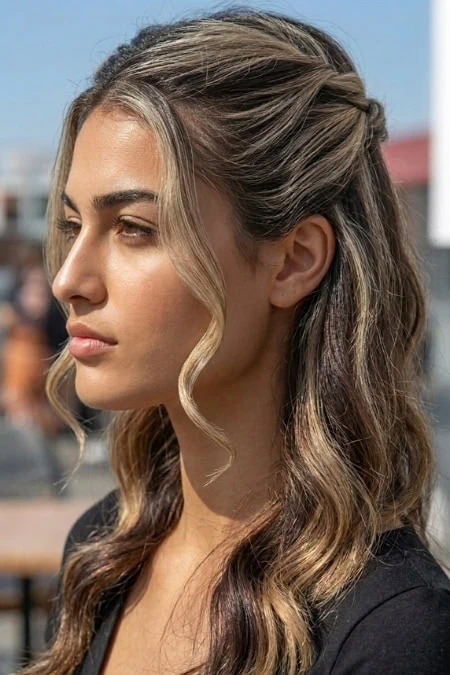
This half-up hairstyle keeps the sides away from the face without pulling everything back tightly.
Sections from around the temples are drawn backward and secured, while long curled tendrils remain free around the front. Those curled pieces fall alongside the cheekbones and lower face, keeping the pulled-back style from appearing too severe.
Keep some lift through the upper section so the top doesn’t become completely flat.
28. Side-Parted Half-Down Hairstyle
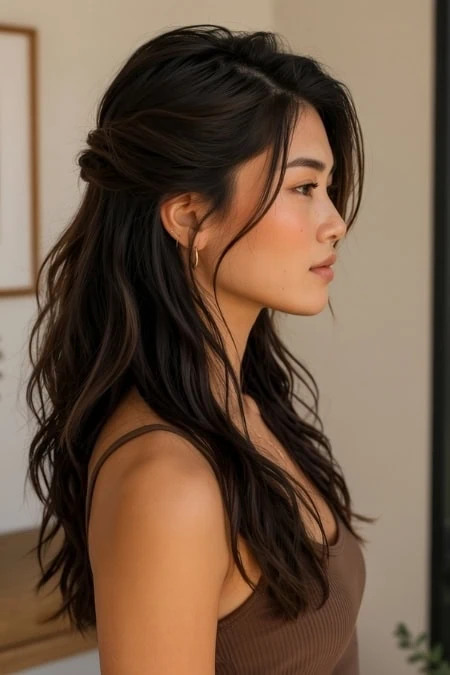
A deep side part does most of the heavy lifting here.
Create the part first, then loosely draw sections from the sides toward the back while leaving the lower lengths down. The front creates a diagonal sweep across the forehead, immediately interrupting the natural symmetry of a square face.
The remaining front lengths fall below the jaw, while a couple of face-framing pieces keep the sides from appearing too sharply pulled back.
29. Soft Twisted Half-Up With A Claw Clip
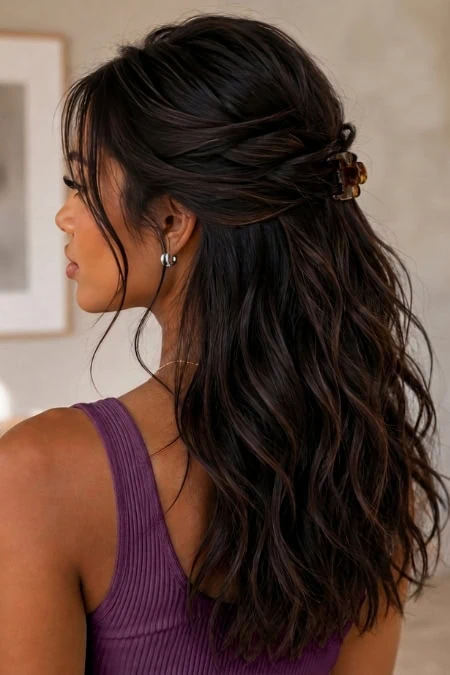
This one swaps elastics and pins for a claw clip.
Loosely twist sections from either side toward the back and secure them with the clip, allowing the remaining hair to fall freely underneath. Because the twists aren’t pulled tightly against the scalp, they maintain some dimension around the upper head.
Leave a few strands around the face and let the lower lengths retain their natural texture. It’s casual, quick, and keeps the style from looking tightly pulled back.
30. Half-Up Messy Top Knot
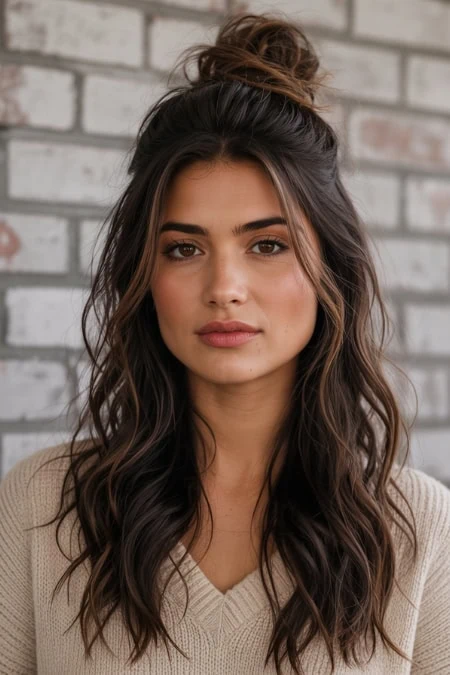
If you want height without putting all of your hair up, the half-up top knot lands right in the sweet spot.
Gather only the upper section into a loose knot positioned high on the head, leaving the entire lower half down. The elevated knot creates vertical dimension, while the remaining waves fall around and below the jaw.
A few wispy front strands make the transition even gentler.
Keep the knot slightly undone rather than shaping it into a tiny ballerina bun. This one benefits from a little chaos.
31. Half-Up Topsy Tail
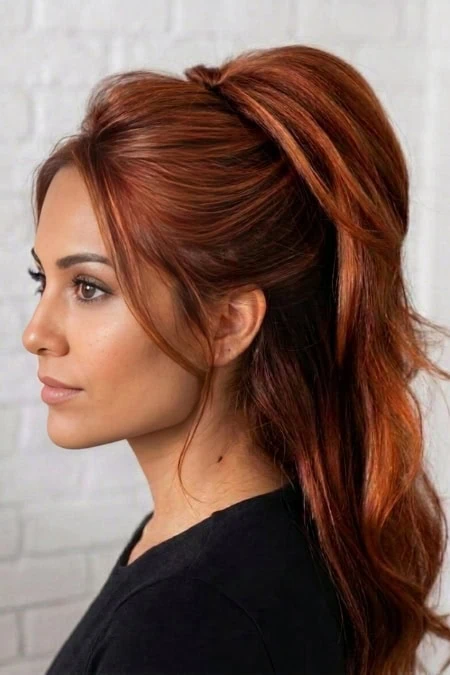
The topsy tail brings curves into the hairstyle in a completely different way.
Gather the upper portion into a loose ponytail, make a small opening just above the elastic, then flip the ponytail through it. That simple turn forms twisted, rounded sections through the back while the remaining hair stays down.
For a square face, the combination of gentle upper volume, curved twists, and long lower lengths keeps the silhouette from becoming too flat or geometric.
How To Choose The Right Square Face Hairstyle
With 31 options on the table, narrowing things down can suddenly feel like its own beauty project. An easy way to choose is to think about what you want your hairstyle to do for your face.
Maybe you want to create the appearance of more length. Maybe you’d rather soften the lines around your jaw. Or perhaps you love your angular bone structure and have absolutely no intention of hiding it. In that case, carry on.
If you want to visually lengthen your face: Look for hairstyles with height through the top or crown, longer layers, cascading waves, angled cuts, and other elements that direct the eye vertically. A pixie with crown volume, angled lob, or long layered cut can all help create the impression of a slightly longer face.
If you want to soften a strong jawline: Bring in curves and varied texture. Waves, feathered layers, wispy face-framing pieces, curtain bangs, Bardot bangs, and tousled cuts can contrast with the straighter lines of the jaw. Pay attention to where your layers end, too. Having them fall above or below the jaw rather than stopping directly at its widest point can make a noticeable difference.
If you want to break up facial symmetry: Go off-center. Deep side parts, asymmetrical cuts, side braids, diagonal lines, and low side updos shift the visual focus away from the middle. Even something as simple as draping a braid over one shoulder can change the overall proportions of a hairstyle.
If you want to showcase your jawline: Forget about softening it and let that bone structure have its moment. Pixies, pulled-back styles, half-up hairstyles, and updos can expose more of the face and draw attention to a defined jaw. Sometimes the feature you’re supposedly meant to “correct” is the one worth showing off.
Hairstyles To Be Careful With When You Have A Square Face
First things first: there is no forbidden-hair list for square faces. If you love a blunt bob or pin-straight center part, you’re allowed to wear it without the hair police knocking on your door.
That said, certain elements can emphasize the width and angularity of a square face rather than counterbalance them. If your goal is to make your features appear less angular, these are worth paying attention to:
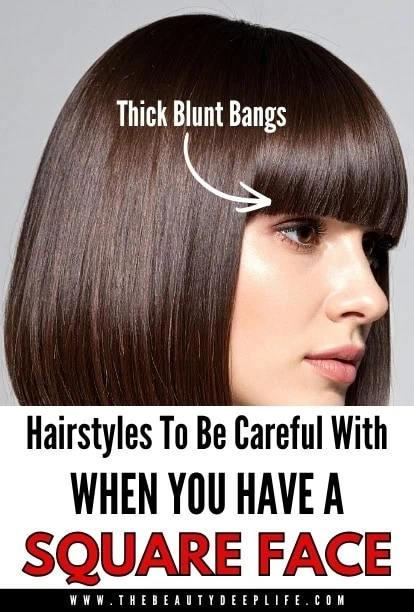
- Thick, blunt bangs: A dense fringe cut straight across can visually emphasize the width of a broad forehead. A lighter, separated, or sweeping fringe provides more variation.
- One-length cuts ending at the jaw: When the entire perimeter stops directly beside the widest portion of the jaw, it can draw additional attention to that width. Going slightly shorter or extending the length below it changes where the eye lands.
- Very boxy bobs: A blunt, geometric bob can echo the straight lines of a square face. Texture, an angled perimeter, curved ends, or longer front pieces can alter that effect.
- Extremely flat hair: Hair that sits very close to the top of the head can make facial width more noticeable. Even a modest amount of root or crown lift adds vertical dimension.
- Tight, symmetrical pulled-back styles: Pulling every strand straight back can put the entire facial outline on display. If you’d rather counterbalance that effect, ease up around the roots or release a few pieces around the temples and jaw.
- Heavy volume directly beside the jaw: Width concentrated at the same level as the jaw can make the lower face appear broader. Shifting that fullness higher or farther down the lengths creates a different silhouette.
None of these styles are inherently unflattering. In fact, if you want to emphasize a strong jaw and angular features, some of them may be exactly what you’re looking for. Consider this section a strategy guide, not a rulebook.
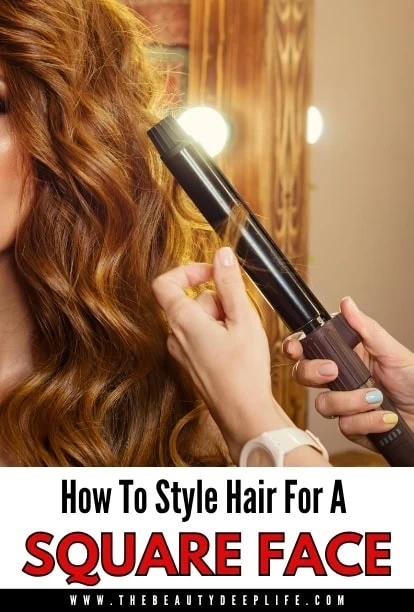
How To Style Hair For A Square Face
Sometimes a styling change can do just as much as a trip to the salon. A different part, a little extra lift, or a few released tendrils can transform a style you already wear.
Add height through the top. A little lift through the front or crown draws the eye upward and gives the overall hairstyle more vertical dimension. This works particularly well with pixies, ponytails, buns, and half-up styles.
Experiment with your part. A deep or slightly off-center part creates a diagonal direction across the forehead and can break up the natural symmetry of a square face. Don’t write off a center part, though. Paired with curtain bangs, layers, or waves, it can still work beautifully.
Be strategic with face-framing layers. Rather than having every shorter layer stop directly at the jaw corners, use varying lengths that fall around, above, and below them. This keeps the framing from forming one concentrated line across the lower face.
Bring in waves and bends. Curves provide contrast against an angular facial outline. You don’t need a head full of elaborate curls either. A few loose bends through the mid-lengths can be enough to alter the silhouette.
Leave a few pieces free with updos. Instead of pulling every strand away from your face, release a couple of wispy or wavy sections around the temples, cheekbones, or jaw. They’ll break up the outline while the rest of the hair stays up.
Embrace texture. Perfectly uniform hair can sometimes make a hairstyle appear more structured. Feathered ends, tousled sections, irregular waves, and separated pieces break up that rigidity.
Use asymmetry to your advantage. Side braids, deep parts, asymmetrical lobs, and off-center chignons all shift visual weight away from the middle. Your hairstyle doesn’t have to match perfectly from one side to the other. In fact, that’s rather the point.
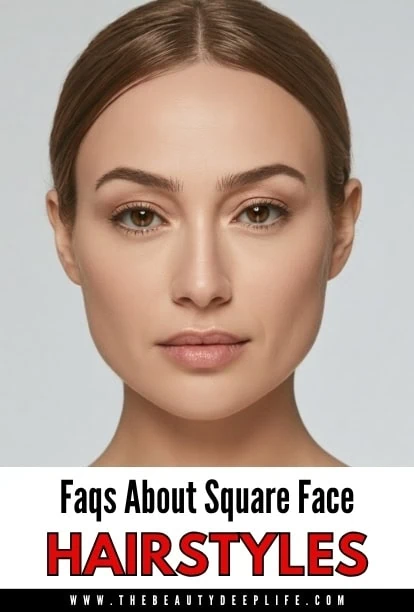
FAQs About Square Face Hairstyles
What hairstyles look best on a square face?
Some of the best square face hairstyles incorporate height, curves, varied texture, or asymmetry. Long layers, waves, textured lobs, angled cuts, shags, curtain bangs, side braids, and loosely styled updos are all strong options. The best choice ultimately depends on whether you want to soften your angles, visually lengthen your face, or emphasize your bone structure.
Are short or long hairstyles better for a square face?
Both can work. Long hair provides plenty of opportunity for cascading layers and waves that draw the eye downward, while short cuts can highlight your cheekbones and jaw.
Are layers good for square faces?
Yes. Layers can prevent the hair from forming a heavy perimeter around the face and give longer cuts more dimension. Face-framing layers are particularly useful when they vary in length instead of all stopping directly at the jaw. Butterfly cuts, shags, and long layered styles are good examples.
What bangs are best for a square face?
Bangs with curved shapes and changing lengths tend to work particularly well. Curtain bangs and Bardot bangs both provide longer sections around the sides of the face rather than creating one dense line across the forehead. Wispy fringe can also work well, especially when incorporated into a layered shag.
What bob length works best for a square face?
If you want to deemphasize the width of your jaw, consider a bob that falls above or below its widest point rather than stopping directly alongside it. An angled bob with longer front sections, a shoulder-skimming lob, or a rounded bob with curved ends can all work. The shape and texture of the cut matter just as much as its exact length.
Does a middle part look good on a square face?
It certainly can. A middle part emphasizes facial symmetry, so it may make a square shape more noticeable, but that isn’t automatically a bad thing. If you want to counterbalance that symmetry, pair a center part with curtain bangs, flowing waves, or face-framing layers. If you’d rather shift the focus off-center, try an off-center or deep side part.
What hairstyles can soften a square face jawline?
Waves, feathered layers, textured lobs, shags, and wispy face-framing pieces can introduce curved or irregular lines around a defined jaw. Length that continues below the jaw can also shift attention downward, while crown height draws the eye upward.
Final Thoughts On Square Face Hairstyles
When it comes to the best square face hairstyles, think about what you want to emphasize. Crown height can draw the eye upward, waves and layers can give angular features a more fluid frame, and an off-center part or asymmetrical style can completely shift the silhouette. Bangs offer yet another way to change how your forehead and cheekbones are framed.
Whether you go for a cropped shaggy pixie, an angled lob, waist-skimming waves, a loose braid, or a wispy ponytail, the right choice is ultimately the one that makes your features work exactly the way you want them to.
We want to hear from you! Which one of these favorite square face hairstyles is your favorite?
Related Articles:
- Haircut For Face Shape: The Ultimate Guide To Flattering Styles
- The Ultimate Bangs Guide: Styles That Frame, Flatter & Transform
- Updos For Medium-Length Hair That Prove You Don’t Need Long Hair
- Warning: These Lob Haircut Ideas May Cause Serious Hair Envy
- Haircuts For Wavy Hair: Enhance Your 2A, 2B & 2C Texture
- 39 Trending Wavy Hairstyles For Short, Medium & Long Hair
- Straight Hairstyles: The Ultimate Guide For Every Length & Style